Sample Detector
When people search "sample detector," they usually want a tool that reads where the beats, bars, and section breaks fall in a track, so an edit lands on a natural boundary instead of mid-note. Audjust does that detection and then uses it to change the song's length. It runs in your browser, it's free, and there's no signup or install.
Here's why the detection matters. If you trim or repeat a song at a random spot, you get a click or an awkward stutter. Audjust scans your file, marks the beat grid and the section breaks, and snaps your edits to those points so a shorter or longer version still sounds intact.
More content below
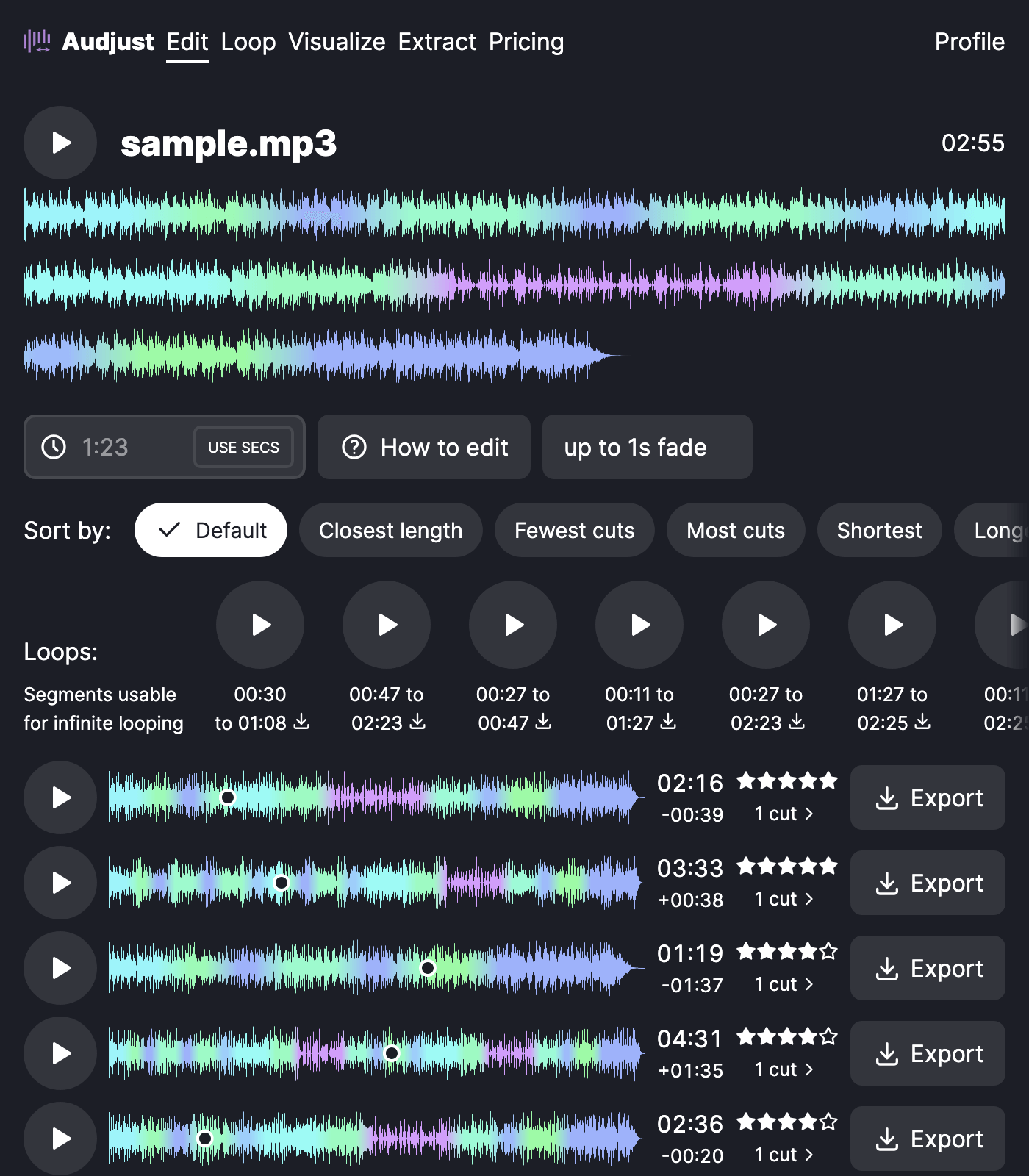
To use it: open the editor and drop in an MP3 or WAV. Wait a few seconds while it analyzes the file and detects the boundaries. Then drag the handles to set the length you want. Audjust splices at the detected points rather than cutting straight through a beat.
Two common cases. You need a song to fit a 30-second reel, so you trim a verse at a section break with no obvious seam. Or you're making a ringtone or loop and want the repeat to land on the downbeat instead of a fraction off. It's also handy for tightening an intro or outro for a presentation or performance.
One tip: steady, cleanly produced music gives the sharpest detection. Live or rubato recordings have looser timing, so check the suggested cut and nudge it by ear.
A common question: does it identify what song a sample came from? No. It detects the rhythmic and structural points inside your own file for editing, not the source of a sample.
Start editing for free! →
No account or email required
